
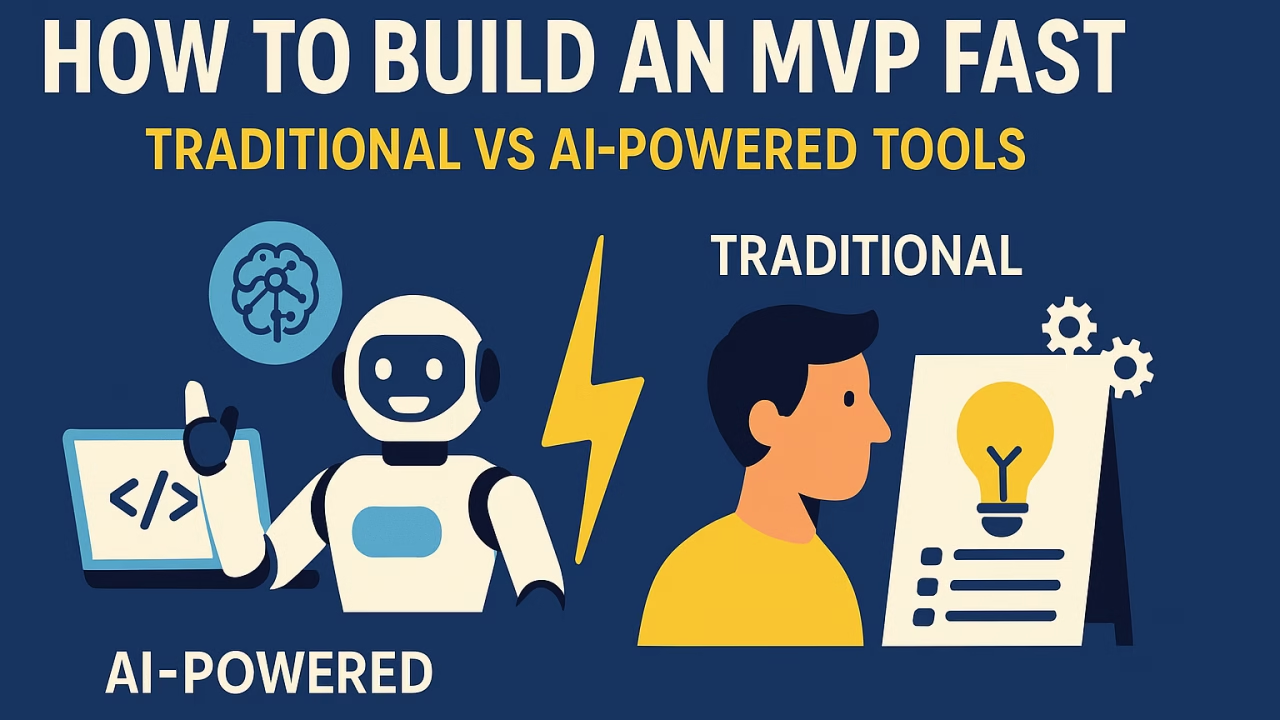
Speed and smart iteration are the heartbeat of successful startups, and harnessing AI tools is changing the game for MVP development. Discover how early adopters are skipping lengthy buildouts, gaining sharper insights, and staying ahead in competitive markets by embracing lean, AI-powered strategies that transform ideas into action—faster and more effectively than ever before.
The Critical Role of MVPs in Startup Success
A Minimum Viable Product represents the smallest iteration of a startup’s vision that delivers value to early adopters and enables meaningful learning. Strip away the perfectionism; the MVP is not about bells and whistles. It’s about answering this core question: will anyone use this? Startups face extreme uncertainty, and the MVP is the shield against building in the dark. By deploying a basic but functional version early, founders expose their assumptions to real-world feedback, dramatically reducing wasted effort on features or concepts no one needs.
The power of an MVP is its role as a risk mitigator. Rather than spending months or years developing something polished and complete, teams release a lean version to quickly validate hypotheses. This rapid release reduces market risk and technical uncertainty, exposing gaps or opportunities before sunk costs pile up. Just as importantly, early adopters become a source of actionable data—pointing out what’s broken, what delights, and where the next investment should go.
Learning through iteration sets a virtuous cycle in motion. Each release feeds new insights into the next development sprint, allowing for rapid adaptation or even a strategic pivot if the market signals demand something different. Speed isn’t an artificial metric; it means compressing the build-measure-learn loop to accelerate innovation and outpace competitors. In a landscape where attention and capital are scarce, releasing an MVP fast means maximizing feedback, adjusting quickly, and building a path to product-market fit before resources run dry.
How AI Tools Transform MVP Development
The bottlenecks that once slowed MVP development—manual coding, slow design processes, endless customer surveys—are being dissolved by the latest wave of AI tools. Instead of struggling to sketch out interface ideas from scratch, founders now use AI-driven wireframing platforms that transform text prompts into interactive layouts in minutes. What once took a full sprint can happen overnight. Even on the technical side, AI code generators rapidly translate logic or pseudo-code directly into workable front-end and back-end code, slashing a month of engineering down to days. This lets startups float their riskiest assumptions faster, whether they’re testing a workflow or integrating with third-party APIs.
AI is also streamlining how early teams interact with users. Embedding AI chatbots isn’t just about automating FAQ responses—a bot trained on early product data can probe deeper, surfacing real objections as users engage. Synthesizing this feedback empowers fast design pivots before the product hits a wider market. On the UX front, AI-powered optimization tools analyze user behavior in real time, pinpointing where hesitation or confusion arises. Refinements that used to rely on gut feeling or after-the-fact usability studies can now be made within the same build-measure-learn cycle. This closed loop bolsters confidence in each new release, giving startups the agility to outmaneuver slower competitors.
The feedback network doesn’t stop at product design. AI-driven market analysis tools parse trends, competitor moves, and customer sentiment, offering unique insight that once took days of research. By layering these insights into planning, teams can prioritize features with actual demand rather than just founder intuition. Non-technical founders, in particular, find a new superpower here—AI makes validating a concept less dependent on specialist skills, democratizing the path from idea to scalable MVP.
Selecting the Right AI Tools for Your Startup
Choosing the right AI tools for your MVP is less about the tech’s bells and whistles and more about focus: does it enable fast learning about your customers and product risks? Start by clarifying your primary goal—prototyping, feedback, analytics, or automation—then work backwards, rating options against your leanest path to real user data. Key criteria come into play: ease of integration (can you implement this without a team of specialists?), scalability (will this break under growth?), supported platforms (does it fit with your stack and your users’ devices?), and finally, cost structure (will a sudden user spike cripple your runway?).
For rapid prototyping, look for visual AI builders that turn prompts into interactive elements—saving days translating ideas to wireframes. If analytics is your bottleneck, prioritize tools that provide actionable, real-time behavioral data. For startups relying on fast user feedback, deploy conversational AI that gathers nuanced responses, not just star ratings. Smart automation platforms are invaluable when you need to automate onboarding or customer support flows—freeing your team to focus on iteration rather than manual repetitive work. Consider how adding AI-powered automation directly into core business processes changes the cost-benefit equation, multiplying each team member’s output. Remember, the right tool is the one that tightens your build-measure-learn loop—not the one with the longest features list.
AI-Driven Strategies for Faster Iteration and Growth
Embracing AI tools isn’t just about getting your MVP to market; it’s about setting the stage for relentless, fast-paced iteration after launch. The most effective founders see their job as accelerating the feedback loop. AI-powered analytics don’t just collect data—they detect new patterns in user actions that would go unseen by the naked eye. Within hours of releasing a feature, you can surface which flows cause drop-off, which buttons are never touched, and which copy drives conversion. This precision enables focused experiments. AI-driven A/B testing platforms now allow simultaneous testing on live traffic, automatically reallocating exposure to high-performing variants and surfacing winners much sooner than traditional cycles allowed.
User input, too, is amplified when AI works behind the scenes. Natural language processing can cluster user reviews, distilling the spirit of customer sentiment into actionable insights. These algorithms transform once-noisy qualitative data into signals for your next sprint, helping teams avoid chasing vanity metrics in favor of building what users actually need. AI personalizes feedback loops: if a feature triggers confusion, targeted questions or onboarding nudges are dispatched automatically, increasing the density of learning.
These feedback engines become even more potent when connected to systems that act on insights. A rapid cycle of build-measure-learn is only possible if detection is matched with adaptation. Imagine an MVP that tweaks itself in small ways every week, while you focus on your next strategic bet. With tools that turn real-time data into actionable directions, every sprint compounds your knowledge of the market. In this environment, the advantage shifts: it’s not the largest teams that win, but those who learn and adapt fastest. Don’t wait—start building with us, and set your cycle of innovation in motion.
The momentum and clarity that AI brings to MVP development are reshaping what’s possible for founders ready to leap ahead of the curve. The path to market is no longer burdened by bottlenecks and guesswork—instead, it favors teams who channel curiosity into swift experimentation and bold iteration. If you’re inspired to accelerate your own startup’s evolution and want guidance tailored for this high-velocity landscape, there’s no better time to start building with us. Let’s turn your vision into reality, fast.
Leave a Reply